
Renaissance? Like that Renaissance?
I really didn’t like European History in high school. Doesn’t mean I didn’t pay attention to everything.
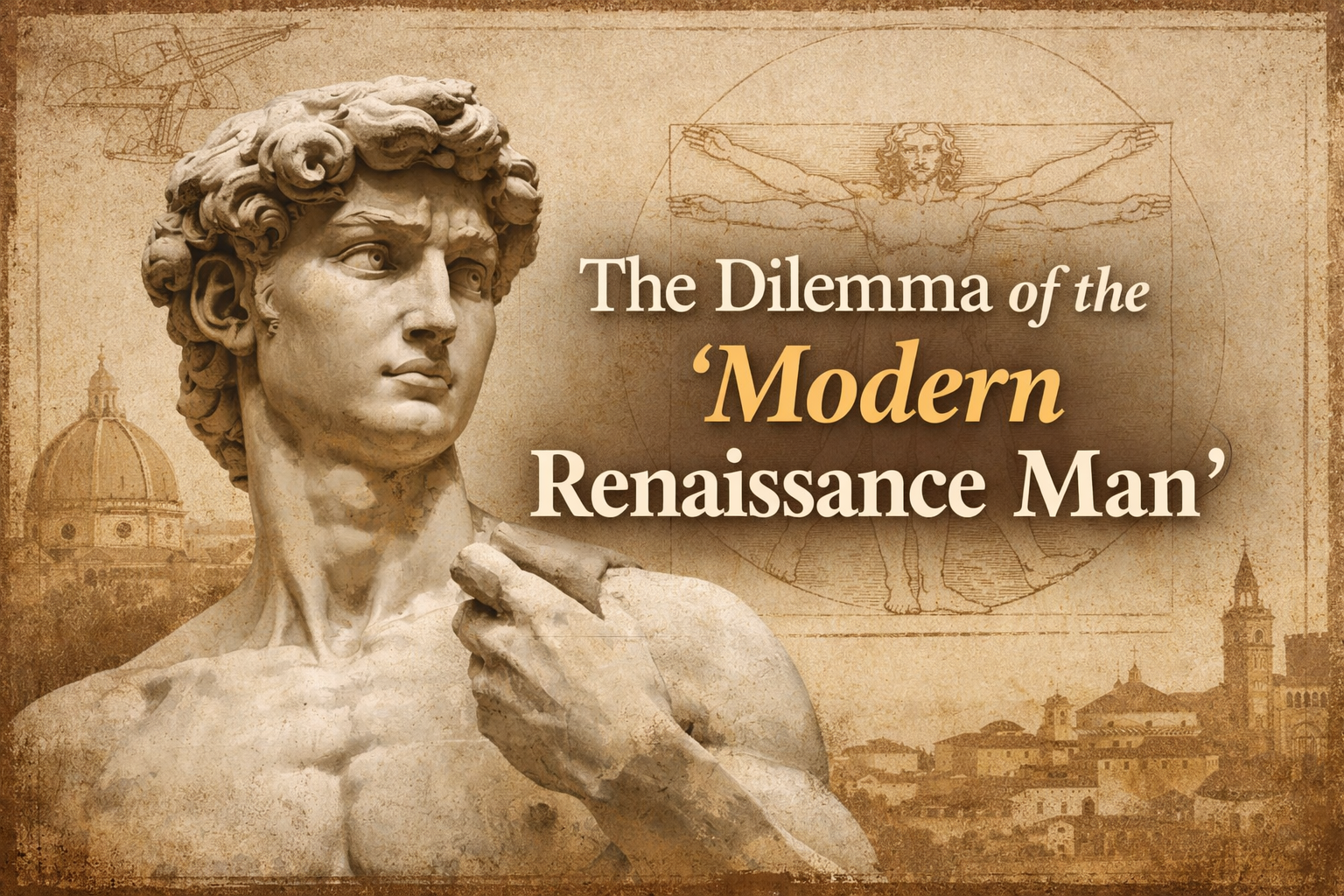
The Renaissance period was an era of great cultural rebirth, with profound innovation in the arts, science, and thought. It was defined by renewed curiosity, human potential, and cross-disciplinary growth. And within this era, birthed the embodiment of its spirit—the Renaissance men.
These men were the gleaming light that crossed inter-galactic realms of intellect and progress. Well-rounded by nature and highly sought out by society, the names Leonardo da Vinci, Michelangelo Buonarroti, Donatello, and Raphael stand out amongst others. Their brains amassed revolutionary ideas that pushed boundaries and advancement as we know it today.
And they took pride to be this way. They wanted to be recognized in multiple fields at a high level (wonder how much further they could have went if they were able to listen to David Goggins on a podcast wearing AirPods while they worked).
The ‘Modern Renaissance Man’
(And obviously, I am not referring to just men in this case, but all of the Renaissance women out there as well.)
What does the 21st century version of this individual look like these days? He excels in his career, he takes care of his body, he exercises the brain as much as his chest, he keeps his finances in check, he has outside activities that excite him, he enjoys conversing about the things that excite him, he maintains strong relationships.
This sprinkle of skill in many dimensions of life helps to balance the null moments that pop up. Obsession may show up in phases, but the Modern Renaissance Man focuses on consistency and continual growth.
The Dilemma of the ‘Modern Renaissance Man’
This sort of versatility sounds ideal. “You are a Modern Renaissance Man”, you’re told in a complimentary way, but there’s much more to that. And that’s where the dilemma arrives.
As we get older, the reality of time creeps in the back of the mind at night, like an awkward interaction at the grocery store might. There are only 24 hours in the day, and all of the things I “want to do” doesn’t line up with what’s imperative to do.
With all that said, there are three main internal struggles that I’ve gathered personally or in conversations with others that live out this lifestyle:
- Lack of elite specialization
- Difficulty in making high-magnitude life decisions
- Not finding your group
1. Lack of Elite Specialization
I’ve been thinking a lot about purpose and how it interacts with legacy in a person’s life. Our name is one of the only things that outlives us, but even that has a shelf life based on how impactful we were during our life.
Here We Are Still Talking About a Bunch of Dead Guys
Obviously, there are the Hitlers and Mussolinis of history that were impactful for not-so-great reasons, but positive impact certainly keeps its ad space in the history books. Here I am opening up this blog post talking about guys that have been dead for over 500 years (heck Leonardo, Michelangelo, Donatello, and Raphael were so impactful that we felt the need to name four, adolescent, sewer-dwelling, crime-fighting turtles after them).

Miles Teller’s character in Whiplash presents this precise idea when Andrew said the above quote. This quote was in reference to Charlie Parker, who died at the hand of a crippling alcohol and heroine addiction, while being widely known as one of the greatest and influential musicians to have ever played.
How do we get there?
We do have the people that stand out in history that have made their impact on multiple fields. However, most of those we know in this stand-out category, are specialists in one field and have been able to spend their time honing in on that one craft. You don’t get to the level of recognition at something by not working at it religiously.
The Modern Renaissance Man has no problem doing the work, but this work is often scattered across a bunch of different projects and areas.
Finding true specialization at an elite level can be difficult due to a bunch of conflicting interests being “in the way”. Putting the majority of your time into one thing means that you are putting aside a bunch of things. The more versatile you are, the more you are leaving in the shadows.
I think about professional musicians and their not-so-great historical metrics with marriage. It makes sense since most of these people that get to the household name level, got there because they put their craft above all else (including their marriage and family). Writing, recording, touring, etc. all creates a restraint on the amount of time that goes into maintaining a healthy structure needed in a marriage. Sure, a lot do make it work, but that one thing stands out to them so much it almost becomes inevitable at times.
2. Difficulty in Making High-Magnitude Decisions
Along the same lines as specialization, the cost of missing out on the other 25 things you can do with your time becomes very prevalent when making important decisions in life—Economists would refer to this as “opportunity costs”.
We hear so many times in success stories that somebody made XYZ decision because “it was the only option”, or at least they felt that way.
What happens when it doesn’t feel like the only option?
What happens when you feel like you can give up so much other stuff that you have passion for and are skilled at?
You can imagine the increased cortisol that ruminates the air when weighing those options.
After all, life is just a series of decisions and they all take you to different places. One of the best (if not, the best) decisions I have made was to leave my hometown right after college and move to Nashville (check out this post if you are wondering if this is a good choice for you too).
There were probably a hundred different places I could have went and it would have ended up being alright I’m sure. But quickly coming to the final decision of Nashville and not second guessing that helped to eliminate this feeling of “missing out” on the alternatives.
Here are some examples of where this might show up:
- Do I stay in corporate or build something?
- Do I move cities or stay near family?
- Do I double down on grad school?
- Do I travel while I can or save money?
- Do I build now or explore more?
It’s not necessarily choosing between good and bad. It’s simply choosing between the options of good outcomes and what is it that I really want.
3. Not Finding Your Group
This was a point that I didn’t even think much about until it came up in conversation with a close friend of mine… and he was right.
There’s a subtle loneliness that occurs. Sometimes there is something that just feels a little “off” and you can never find that group that fully understands you.
Maybe you want to get into running, but the run clubs are full of people training for a marathon. Perhaps, you want to get into working out, but the local sporting center is filled with ‘gym-rats’. You don’t fit in all the way with the other finance guys, or the academics, or the creatives. You simply just overlap with them at times.
Your part-time fascination and interest does not align with others’ obsessions. These shared obsessions are what build tight bonds. And when you’re looking for friends, this can be difficult. You either meander into a version of yourself that is inauthentic, or you just take it for as it is and find yourself in the same boat.
It’s not the identity crisis in the sense of not knowing who you are. Instead, you do know who you are but there’s a limited supply of like-minded individuals.
It can feel isolating.
At least in college, the people you don’t appear to have anything in common with at all, you might have the same class and can both connect on the upcoming exam or how the professor loves that one phrase.
The Silver Lining
There is good news in all of this, and it’s something I have to remind myself quite a bit when these thoughts occur (obviously it’s a pretty prevalent thought of mine if I’m writing an entire blog post about it).
And no, this is not the section where I start bashing all of the “one-trick ponies” out there—I did just spend most of this blog explaining where it might be advantageous to have that frame of mind.
1. Building Range
Things might not be all in order for you now, but you need to stop thinking so immediately. Sure, specialization is a strong way to get a lot of momentum going quickly, but having a touch in multiple domains tends to be where you can see connections that the specialists might miss.
I always thought about a plan for my career where if I can learn all the boring stuff that comes easier to others, then the stuff that comes easier to me or interests me will be my advantage over them.
Maybe, just maybe, you can obtain 80% of the business knowledge of your counterparts, but you might also understand psychology, or communication, or martial arts, or media arts. And this is how people find niche jobs that suit their individualism, while being high in demand and low in supply.
Elite specialists often win early. Integrated thinkers often win long-term.
2. Power in Optionality
It might be difficult to make big-time decisions as I laid out above. But it also might give you leverage and confidence to know it’s going to work out no matter what it is you decide.
Being tapped into a bunch of arenas can help you to:
- Change industries
- Move cities
- Start something
- Leave something
- Reinvent yourself
It can feel overwhelming having options. But if you went to a restaurant and the menu only had 5 dishes in which none of them really sounded appetizing to you, would you enjoy that experience as much as, say, going to the Cheesecake Factory?
In post-grad life, our preferences change, our attitudes change, we change. Having the option to change is more of a freedom than anything. It is a privilege to have choices, especially when not everybody does.
3. Identity That Isn’t Volatile
In the search for identity, we struggle because it isn’t that one thing. But the problem with it being one thing is that if you lose it, you lose a huge part of your identity.
If you are the “banker”, or the “athlete”, or the “scholar”, what happens when things crack?
These things might be partly out of your control too:
- You lose your job
- You get injured
- You get burned out
- The market shifts out of your favor
My father always tells me about all of the talent that exists out there but we only hear stories about the ones who make it. There might be a million individuals who have the same level of skill (or even more) just chilling in their apartment somewhere because for whatever reason, the cards didn’t align for them.
The problem occurs because outside of that one thing that made them special, they had no other option to fall back on. That’s great if you make it, but what do you do if you don’t?
There’s a concept in marketing about finding your niche (aka your business identity). Being the best in that niche is one way to stand apart. But also, being the first in a niche is just as good, if not better.
Your unique set of skills and passions is your niche. Embrace that you can be one of few to own that space.
Conclusion: Go Make Your Mona Lisa
Maybe the whole dilemma of the ‘Modern Renaissance Man’ isn’t meant to be solved. Rather, it’s meant to be navigated.
You see the specialist sprinting past you in one lane and wonder if you’re falling behind. You feel the weight of big decisions because you know you’re capable of more than one path. You float between rooms, connected everywhere but not fully claimed by one tribe.
I need to remind myself that it’s not about dominating but discovering.
Heck, I’ve gotten this far being the way I am. And you have too. There may come a season where you narrow your focus. Where you double down. Where you obsess. Where you trade range for edge and climb toward that top 1% in something that truly matters to you.
Sometimes, what we might view as our greatest weaknesses could really be our greatest strengths. Look at the bright side: you have range, you have optionally, and you have an identity outside of one thing. It only feels like negatives because it’s not what we’re used to seeing.
You have the tools. Be patient, and go paint your Mona Lisa.

Or go write your story. Either one works.
—Will


Leave a Reply