

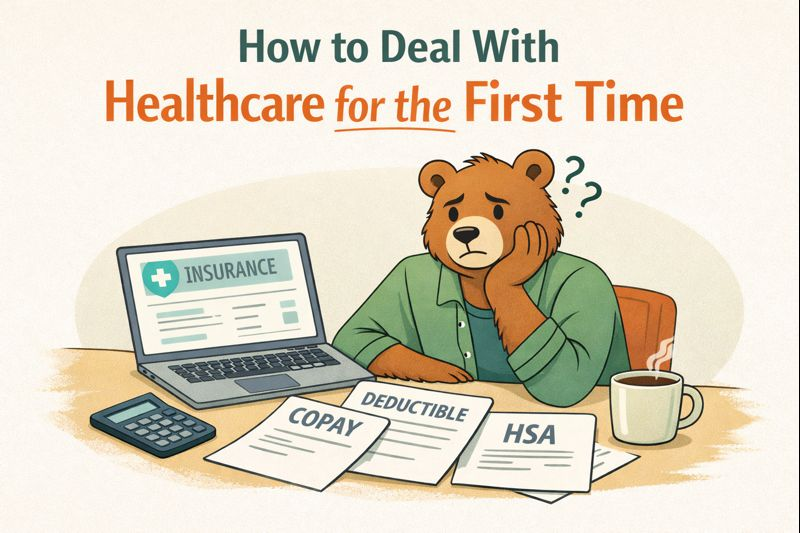
Give Me an H-E-A-L-T-H-C-A-R-E… What Does That Spell?
I had a manager at work the other day ask me if I liked the company-offered healthcare plan… what the hell is that supposed to even mean?
Odds are, if you are under the age of 26, you are still on your parents’ health insurance. For the folks that aren’t, you probably wish you were (I’ll raise my hand there). Not only does this mean you have to pay for your own insurance (boo), but it also means you might feel responsible for having an idea on what it is you’re paying for.
I know my employer drops a couple of options into my lap around the end of the year, and says “take a look at these and let me know your favorite”. But what is it I’m actually looking at, looking for, and looking to do?
Why It All Feels So Confusing
Healthcare is full of jargon (copay, deductible, premium, in-network, out-of-pocket, etc.) and these things are triggered at all different levels. Usually, people pick one plan and just hope for the best.
After all, it’s not like any of us were taught these things in college. Instead, a 5-minute online course and PDF are expected to sufficiently teach you about properly setting up something as important as health insurance.
Most of the time, you don’t really think about it until you actually need care. This, however, is where things can get messed up. Not having things in order can be catastrophic and result in you not getting the care you need, overpaying, and a lot of wasted time and aggravation.
This blog post is here to help you out; to navigate the realm of healthcare, understand what you need and don’t need, and to make such a chaotic topic nice and simple. Let’s talk about how to deal with healthcare for the first time.
Defining the Basics
In the simplest terms, here’s how health insurance works with regards to you:
- You pay each month
- You visit a doctor
- The doctor bills for their services
- Insurance [maybe] pays part of the cost
- You pay the remainder
Out-of-Pocket Costs
I always thought health insurance paid for the entirety of the doctor expenses. News flash: it doesn’t.
While some preventative care like annual physicals are typically fully covered, most other visits are not and require some amount paid out-of-pocket. Out-of-pocket costs are the remaining amount that you need to pay, after insurance has paid their portion.
It’s important to know this because a lot of times there will be a cap on your total out-of-pocket expenses for the year. Once this cap is hit, your insurance will cover all of the subsequent medical bills.
Deductible
Your deductible is the amount you have to pay out of pocket each year before your insurance really starts sharing costs.
For example, your plan might have a $2,000 deductible. This would mean that the insurance won’t kick in until you pay $2,000 in covered medical bills yourself. Some plans have copays before the deductible is met, but things like lab work, imaging, emergency room visits, therapy, and procedures will be your sole responsibility at the negotiated insurance rate.
As far as the difference between the deductible and out-of-pocket maximum, think of it this way: your deductible is the entry fee. Your out-of-pocket max is the emergency brake.
Copayment and Coinsurance
A copayment is a fixed dollar amount you pay for a specific type of care. Think of it like a flat fee to walk through the door.
Certain visits have certain set prices that you pay, like any other coffee shop or department store. These copayments contribute to your total out-of-pocket expenses.
Coinsurance is a percentage of the cost that you pay after you meet your deductible. Here, you and your insurance provider are splitting the bill. For example, if you have 20% coinsurance on a $1,000 medical bill, you pay $200 and your insurance pays the $800.
Health Savings Account (HSA)
The HSA is a pre-tax account that allows you to save up money to pay for medical-related expenses. It is one of the few places where the system actually works in your favor—if you know how to use it.
An HSA has what they refer to as “triple tax advantages”. Basically, this means that any funds put into the account are tax-free. Any growth you may have in the account is tax-free (yes, you can invest this money in stocks, bonds, and other securities). And the money you withdraw to pay for medical expenses is also tax-free.
On top of that, the money rolls over year-over-year, and if you change employers, the account stays with you.
What can you use the money for? Things like doctor visits and prescriptions are obvious. But also can be used for therapy sessions, dental and vision expenses, and I even know a couple who used funds for baby-related expenses after the birth of their first child.
You can check sites like HealthEquity.com to see the full list of eligible items. You’d be surprised what is covered.
Understanding the Difference in Plans
Most of the time, you have the option between two main types of health insurance plans and it’s important to know the difference, so you can pick which is best for you.
The main two types are a high deductible health plan and a low deductible plan. Here are the breakdowns of each:
High Deductible Health Plan
- Higher deductible –> greater out-of-pocket costs before insurance kicks in
- Lower monthly premium
- Allows you to pair with HSA
This plan is good for generally healthy people, who don’t go to the doctor that frequently, and want to keep a low monthly payment for their insurance.
Low Deductible Plan
- Lower deductible –> lower out-of-pocket costs before insurance kicks in
- Lower cost when you use healthcare
- Expenses are more predictable
This plan is good for people that might have chronic conditions, regularly maintained prescriptions, and want peace of mind to go to the doctor more frequently.
Before you decide on a plan ask yourself these questions:
- How often do I go to the doctor?
- Do I take regular prescriptions?
- Do I value lower monthly cost or predictability?
- Can I afford a higher bill if something unexpected happens?
I personally go with the high deductible health plan. That said, I have a surgery scheduled this year that’s going to be more expensive because of the plan I chose. When choosing the plan, it’s not a matter of good vs bad. It’s a matter of being realistic with what you need it for.
What You Should Really Be Using Healthcare For
It sounds silly but it’s there to be healthy. And if something doesn’t feel right or seem right, it’s better to go early and be told it’s nothing than to go too late and now have an emergency.
At the very least, take advantage of what’s included in your plan. Have an annual physical and go to this appointment with questions. That’s literally what they’re there for. Get blood work done to see if your numbers are all in line. If you have dental, go get your teeth cleaned every 6 months.
With this being said, find a good doctor that you trust and feel comfortable with. You want to be honest with your doctor and let them make any recommendations they can (at the end of the day, you don’t have to take any of the advice but at least you’ve heard it).
If you want to look into additional care such as therapy, see what your plan offers and call and ask. I have a friend who realized he could see a therapist for the cost of a small copay. Once you get all of the information, then you can make the decision of whether to go or not. But it certainly doesn’t hurt to inquire.
If You Do One Thing After Reading This
Real quick. If you do nothing else, spend five minutes on these 4 things:
- Log into your insurance portal
Find your deductible, out-of-pocket maximum, and what preventative care is covered. - Schedule your annual physical
Even if nothing feels wrong, this gives you a baseline and puts the system to work for you. - See if you’re eligible for an HSA
If you’re on a high deductible plan, this is one of the most useful tools available to you. - Keep this information in your back pocket
Open enrollment comes around fast, and it’s easier to make decisions when this isn’t your first time seeing the information.
This way you know what you have, what you don’t, and what is set up for the future. Good luck out there, champ.
Conclusion: Just You and Your New Pal, Mr. Deductible
Nothing in this life is free if you haven’t figured that out already, and health insurance is another one of those things. And since you have to pay for it, you should probably know what you’re paying for.
Most people don’t truly understand health insurance when they first leave college. They learn by trial and error, by unexpected bills, or by avoiding care altogether because they’re unsure how it works. Taking the time to learn the basics is already a huge step forward.
So if you don’t feel like you have a full grasp on things, don’t be alarmed. That’s perfectly normal.
Also, please keep in mind that I am speaking as a single, dependent-free man and I’m sure it only gets more involving with marriage and family included.
Figuring out health insurance—yet another part of writing your story. A boring story for that matter, but a story nonetheless.
—Will

Leave a Reply