
The Importance of Early Onset Mentorship
If you haven’t gotten the opportunity to have a trusted mentor in your life, you are missing out.
Having a mentor, especially early on in your career, helps to provide clarity to the unknown (your future). No, they are not fortune tellers by any means, but they do show you the result of what a certain order of tasks and work inputs has created. And you can look at these outcomes and pick which one you like the idea of lining up with.
What went well, what went wrong, what they were thinking, what they should have thought about; these are all great insights that mentors provide. And I do know people of all ages and career stages that actively refer to a mentor, but they are increasingly advantageous early on, for a couple of reasons.
As discussed in the podcast episode with Jimmy Chatfield (click here to check that out), the earlier you are in your career, the less of a “threat” you are to a higher-up. With that, they are much more likely to offer advice, be vulnerable, and take pride instead of rivalry in your successes.
On top of that, the sooner you learn certain lessons, the better most of the time. It’s similar to money with compounding returns—your money is technically worth “more” when you’re younger because it has more opportunities to see compound growth. The sooner you can learn a valuable lesson, the more likely you are to use that to avoid costlier mistakes.
The Myth of the One and Powerful Mentor
Nobody’s perfect and you can’t expect that not to be true. This, however, is where the power of mentorship is limited.
Everybody has different opinions, different ideas of success, different goals and ambitions, etc. You can strive for the same set of outputs as someone while going through a different set of inputs.
On top of that, you should always innately question the “truth”. You should question why things are done a certain way and why they can’t/didn’t happen another way.
We all want that one and powerful mentor to guide us through all the tribulations life has to offer. We want our Yoda. But do you really?
I can tell you confidently, there is nobody out there that is the older version of everything you want. They might have certain skills and areas of expertise that you deeply admire and want to learn from. But they also have things that you would certainly not want to inherit as well. Finding your future carbon copy is impossible.
The nice thing is, you don’t need it to be possible—you just need to be a bit creative with what you have.
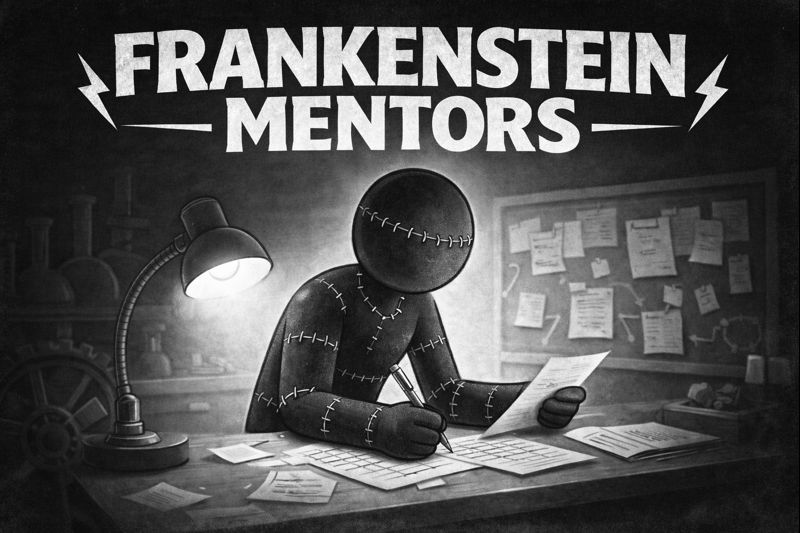
What is a ‘Frankenstein Mentor’?
In simple terms, the Frankenstein Mentor is the combination of different people who each shape a different part of your individual development.
I came up with this general concept a few months ago. I was thinking about those sports radio shows that build the “perfect NFL quarterback” and take specific attributes from different quarterbacks to form the best possible theoretical player to exist. For example, this may have captured Lamar Jackson for his legs, Tom Brady for his clutch ability, Patrick Mahomes for his arm strength, and Josh Allen for his toughness (these were arbitrary names thrown, debate all you want in the comments).
In this scenario, the negatives and downsides of each player are completely thrown out and they simply looking at each player for their standout contributing factor.
The same can be done for mentors. I’m sure there are older people in your life that lay out a career that you would like to be in pursuit of. Or maybe their family structure. Or maybe just the way they handle stress. Whatever it is, think about how easier it is to find multiple people that specialize in one thing, rather than one person that specializes in multiple things.
Do some thinking right now and set a couple of general parameters (work, family, spiritual, etc). Who in your life would be in consideration for your Frankenstein Mentor?
Why the ‘Frankenstein’ Model Works Better
This collective group of mentors is effective because it allows you to be truly honest with the people you learn from. With a single mentor, we might feel the need to justify or provide context for any shortcoming or misalignment with us they might have. This imbalance results in either a lack of reality, or a change in who we are or want to become.
This model laid out leaves room for the natural imperfects that everyone possesses. You can take advice on what you seek as quality character development, while acknowledging what you might do differently. Here are a couple of examples:
- You might have someone in your life that is career driven and ambitious, but you might never take dating advice from them
- You can have someone that knows how to balance their life and rewards themselves for hard work, but you might never take spiritual advice from them
- You might have someone that is terrific with their personal finances, but you would never want to take business advice from them
You’re building a composite model of all the best qualities, while also using your own brain power to determine what aligns with you and what doesn’t. Remember, blindly following someone’s rhetoric, especially someone you actually admire, is a dangerous game.
The 5 Core ‘Mentor Parts’ to Look For
Time to assemble this beast and make it come alive. Maybe there are more, maybe there are less, but this is a good list of possible mentor buckets to held you build your monster.
- The Thinking Mentor
- The Communication Mentor
- The Execution Mentor
- The Life Mentor
- The Industry Mentor
(Cue the thunder and lightning.)

1. The Thinking Mentor
Who:
Someone who makes calm, strategic decisions and thinks in long timelines instead of emotional reactions.
Why:
Early career mistakes often come from rushing or reacting. A thinking mentor helps you slow down, weigh tradeoffs, and make moves your future self benefits from. Use your brain.
Examples:
- Warren Buffett; investor, business owner
- Angela Merkel; former Chancellor of Germany
- Ryan Holiday; author,writer of modern Stoic philosophy
2. The Communication Mentor
Who:
Someone who expresses ideas clearly, handles tension smoothly, and communicates with confidence and emotional control.
Why:
Skill doesn’t matter if people can’t understand you. Communication mentors help you advocate for yourself, navigate conflict, and be taken seriously.
Examples:
- Steven Furtick; pastor, speaker, and author
- Oprah Winfrey; media host, empathetic communicator
- Barack Obama; former President of the United States


3. The Execution Mentor
Who:
The person who takes action, stays disciplined, and finishes things even when motivation fades.
Why:
Careers stall from overthinking more than lack of ability. Execution mentors help you build momentum and turn plans into real progress.
Examples:
- Kobe Bryant; the late, great, professional basketball player
- Elon Musk; CEO of Tesla/SpaceX and more
- David Goggins; endurance athlete and author
4. The Life Mentor
Who:
Someone who has success and balance—they maintain perspective, boundaries, and a full identity outside of their work.
Why:
Without this influence, it’s easy to burn out or tie your self-worth entirely to career performance. Life mentors model sustainable growth.
Examples:
- Tim Ferriss; writer, lifestyle design advocate
- Keanu Reeves; actor, humility and groundedness
- Chris Williamson; podcaster, bro-science and mental health


5. The Industry Mentor
Who:
Someone who understands how career systems work—whether it’s promotions, or leverage, or skill positioning, or timing.
Why:
Strictly hard work isn’t enough. Industry mentors help you move strategically instead of just working harder in the wrong direction. You need to learn how to play the game a bit.
Examples:
- Sheryl Sandberg — Executive, leadership and advancement
- Steve Jobs — Entrepreneur, vision and positioning
- Kevin O’Leary — Investor, business strategy
Conclusion: SCIENCE!
Right now you might be like a fresh baby out the womb; unfamiliar to the world and searching for light. What do you do when you don’t have the light? You seek someone who already does. That person? Your mentor.
Full of wisdom, full of prowess, full of education. Yet, full of flaws and undesirable qualities (sorry to burst your bubble). But heck, we all have those. Some people think clearly but struggle with balance. They might communicate well but don’t execute. Or maybe they’re successful but don’t know how to stop.
If you try to mold yourself on one person, you may be at risk to inherit these weaknesses or, possibly worse, develop blind spots.
So what’s the better move? Build your own.
Take decision-making from one person. Communication from another. Discipline from someone else. Balance from someone who’s grounded. Industry strategy from someone who knows the system.
That’s how you build a life and a career that fits you, not somebody else’s that you’re trying to emulate. That, my friends, is the beauty of the Frankenstein Mentor. SCIENCE!
And as you piece together the strengths that shape you, remember—you’re still the author of the whole thing. Keep writing your story.
—Will


Leave a Reply